Artificial intelligence is no longer a future concept in digital marketing. It is already embedded in how campaigns are planned, executed, optimized, and scaled. From audience targeting to content creation and performance optimization, AI has quietly shifted marketing from manual decision making to intelligent systems.
However, AI is not replacing marketers. It is reshaping how marketers think, decide, and operate. Brands that understand this shift are gaining speed, efficiency, and precision. Brands that misunderstand it risk losing direction, differentiation, and identity.
This blog explores how AI is changing digital marketing across strategy, content, and performance, while also explaining why human judgment remains irreplaceable.
The Rise of AI in Marketing
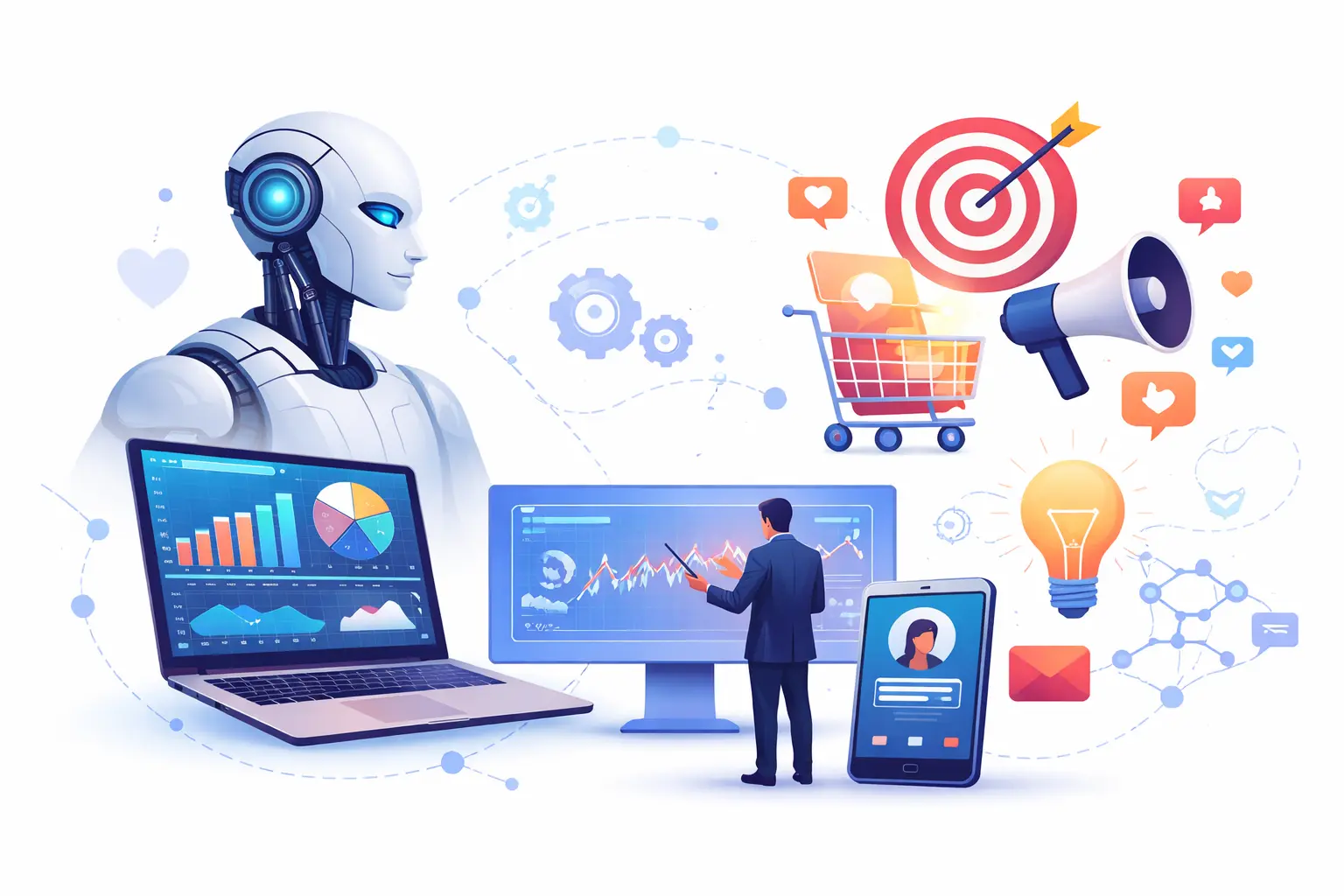
AI adoption in marketing has accelerated rapidly over the past few years. What started as automation tools has evolved into intelligent systems that analyze data, predict outcomes, and support complex decisions.
Marketing today generates massive amounts of data across platforms, channels, and customer touchpoints. Human teams alone cannot process this volume at speed. AI fills this gap by identifying patterns, trends, and signals that would otherwise go unnoticed.
AI is not just improving efficiency. It is changing how marketing decisions are made.
From Tools to Decision Support
Earlier marketing tools focused on execution. They helped schedule posts, send emails, or manage campaigns. AI driven systems go a step further by guiding decisions.
Instead of asking what happened, AI helps answer:
- Prediction: What is likely to happen next
- Conversion likelihood: Which audience is most likely to convert
- Message performance: Which message will perform better
- Budget allocation: Where budgets should be allocated
This shift from execution tools to decision support systems marks a fundamental change. Marketers are no longer reacting to data after campaigns run. They are planning with predictive intelligence before campaigns launch.
AI in Strategy and Planning
AI has moved upstream into marketing strategy and planning. It is no longer limited to optimization after execution.
Predictive Insights and Audience Modeling
One of the most powerful applications of AI is predictive analysis. AI systems analyze historical data, behavioral patterns, and real time signals to forecast outcomes.
In strategy and planning, this enables:
- Segmentation: Audience segmentation based on behavior rather than demographics
- Risk prediction: Prediction of purchase intent and churn risk
- Value identification: Identification of high value customer segments
- Forecasting: Forecasting campaign performance before launch
Audience modeling powered by AI helps marketers understand not just who their audience is, but how they are likely to behave.
This allows strategies to be built on probability rather than assumptions.
Smarter Market and Demand Forecasting
AI also improves market understanding. By analyzing trends, search behavior, and competitive signals, AI tools help brands anticipate demand shifts.
This helps in:
- Timing: Timing campaigns more accurately
- Seasonality: Planning seasonal strategies
- Budgeting: Allocating budgets with confidence
- Efficiency: Reducing wasted spend
Strategy becomes proactive rather than reactive.
AI in Content and Design
Original thinking is often assumed to be purely human. While that remains true at a strategic level, AI has significantly changed how content and design work is produced and scaled.
Faster Production, Smarter Personalization
AI enables rapid generation of content variations. This includes ad copy, visuals, headlines, email subject lines, and landing page elements.
Instead of producing one ad asset, teams can generate dozens of variations and test them simultaneously. This improves speed and learning.
AI also enables personalization at scale. Content can be dynamically adapted based on audience behavior, preferences, or stage in the journey.
Personalization that was once manual and limited is now continuous and scalable.
Production Efficiency Without Direction
While AI accelerates production, it does not define direction. It can replicate patterns, but it cannot originate brand point of view.
Brands that rely solely on AI generated ads often face:
- Messaging: Generic messaging
- Voice: Loss of distinct voice
- Consistency: Inconsistent brand expression
AI supports content teams. It does not replace brand leadership.
AI in Performance Marketing
Performance marketing is where AI has made the most visible impact. Platforms have deeply integrated AI into their advertising systems.
Smarter Bidding, Targeting and Optimization
AI driven algorithms now handle:
- Bids: Bid adjustments in real time
- Audiences: Audience expansion and refinement
- Ads: Ad rotation and selection
- Budgets: Budget pacing across campaigns
These systems continuously learn from performance data and optimize toward defined objectives such as conversions or revenue.
This has reduced manual intervention and increased efficiency at scale.
Automation Changes the Role of Marketers
With AI managing bids and targeting, the role of performance marketers has shifted.
Instead of manual optimizations, marketers now focus on:
- Objectives: Defining the right objectives
- Inputs: Providing high quality inputs
- Interpretation: Interpreting insights
- Alignment: Aligning campaigns with business goals
Performance success depends less on tactical tweaks and more on strategic clarity.
Human Judgment Still Matters
Despite the power of AI, marketing cannot be fully automated. AI lacks context, values, and judgment.
Why Strategy Cannot Be Automated
Strategy requires understanding nuance, culture, emotions, and long term brand vision. These are not data points. They are human insights.
AI can recommend what is likely to work. It cannot decide what should be done.
Human judgment is essential for:
- Positioning: Brand positioning decisions
- Sensitivity: Messaging sensitivity
- Ethics: Ethical considerations
- Tradeoffs: Long term growth tradeoffs
Without human oversight, AI optimizes for short term outcomes at the expense of long term brand health.
The Risk of Over Automation
Over reliance on AI can lead to:
- Messaging: Homogenized messaging
- Strategy: Platform driven strategies
- Differentiation: Loss of differentiation
- Brand: Brand erosion over time
When every brand uses similar algorithms and data signals, strategy becomes indistinguishable.
Human thinking is what keeps brands unique.
Using AI Without Losing Brand Identity
The real challenge is not whether to use AI. It is how to use AI without losing brand identity.
AI as an Assistant, Not the Owner
AI should support decision making, not own it. Brands must define:
- Guidelines: Clear brand guidelines
- Voice: Tone of voice rules
- Boundaries: Design boundaries
- Objectives: Strategic objectives
When AI operates within defined frameworks, it enhances consistency rather than diluting identity.
Aligning AI With Brand Strategy
AI performs best when guided by clear strategy. Inputs matter more than outputs.
Strong brand strategy ensures that:
- Values: AI generated content reflects brand values
- Goals: Optimization aligns with business goals
- Positioning: Performance does not override positioning
AI amplifies what already exists. If identity is weak, AI will scale that weakness faster.
The Future of Digital Marketing With AI
AI will continue to evolve and become more embedded in marketing workflows. Predictive planning, real time personalization, and intelligent automation will become standard.
However, competitive advantage will not come from using AI alone. It will come from how brands combine AI capabilities with human insight.
Brands that win will:
- Speed: Use AI to gain speed and precision
- Direction: Use humans to define meaning and direction
- Balance: Balance efficiency with originality
- Identity: Protect brand identity while scaling performance
Final Thoughts
AI is changing digital marketing, but it is not changing its purpose. Marketing still exists to create value, build trust, and drive growth.
AI improves how marketing is executed. Humans define why it exists and where it should go.
The future of digital marketing belongs to teams that treat AI as a strategic partner, not a replacement. When intelligence and judgment work together, marketing becomes not just faster, but smarter.
Adarsh T S
Digital Marketing Specialist | SEO & Content Strategy | Performance Marketing