
In today's competitive marketplace, businesses often confuse presence with power. They invest heavily in ads, billboards, reels, and promotions hoping to dominate attention. Yet attention alone does not build brands.
The real difference lies in understanding Brand Identity and Brand Visibility. One defines who you are. The other determines how often you are seen. When aligned, they create long term growth. When disconnected, they waste budgets.
This article explores the difference between Brand Identity and Brand Visibility, why visibility alone is not enough, and how businesses can strategically balance both for sustainable success.
What is brand identity
Brand Identity is the foundation of a business. It represents how a company defines itself and how it wants to be perceived. It includes visual elements such as logo, colors, typography, and design language. But it goes much deeper than that.
Brand Identity includes:
- Core values
- Mission and vision
- Tone of voice
- Brand personality
- Customer promise
- Positioning in the market
It answers critical questions:
Who are we?
What do we stand for?
Why should customers trust us?
A strong Brand Identity ensures consistency across every touchpoint. Whether a customer visits your website, sees your social media, or interacts with your sales team, the experience feels aligned.
Without a defined Brand Identity, marketing becomes scattered. Campaigns may generate attention, but they lack cohesion. Over time, this weakens recognition and reduces customer loyalty.
Brand Identity is not created overnight. It is built through strategic clarity and disciplined execution. Companies that invest in defining their Brand Identity early create stronger differentiation in crowded markets.
What is brand visibility
Brand Visibility refers to how frequently and prominently a brand appears in front of its target audience. It focuses on exposure and reach.
This includes:
- Digital ads
- Billboards
- Social media presence
- Search engine rankings
- Influencer collaborations
- Public relations
- Events and sponsorships
Brand Visibility ensures that people see your business regularly. It increases awareness and keeps your brand top of mind.
In performance driven environments, Brand Visibility is often measured through impressions, reach, clicks, and engagement. These metrics help evaluate how widely your message is being distributed.
However, Brand Visibility alone does not guarantee impact. Being visible does not automatically mean being remembered. If your messaging lacks depth or differentiation, customers may scroll past, ignore, or forget your brand.
Visibility creates opportunity. Identity creates meaning.
Why visibility alone isn't enough
Many businesses make the mistake of prioritizing Brand Visibility without investing in Brand Identity. They run aggressive campaigns, boost posts, and scale ads. But when asked what makes them different, they struggle to answer.
Visibility without identity creates noise.
When customers are exposed to multiple brands daily, they subconsciously filter out messages that feel generic. If your brand lacks clarity in positioning, tone, or visual consistency, it blends into the background.
Seen but forgotten
This is one of the biggest risks of over focusing on Brand Visibility.
A brand can be seen thousands of times and still be forgotten. Why?
Because it lacks:
- A distinct voice
- A recognizable design system
- A clear value proposition
- Emotional resonance
Consumers remember stories and experiences, not random advertisements. If Brand Visibility is not supported by a strong Brand Identity, the brand becomes just another name in the feed.
Businesses often misinterpret campaign metrics as brand strength. High impressions may look impressive on dashboards, but if recall is low, long term growth suffers.
True success requires more than being visible. It requires being recognizable and trusted.
Role of identity in recall
Brand recall is the ability of customers to remember your business when they need a product or service. This is where Brand Identity plays a powerful role.
When Brand Identity is consistent and distinctive, customers begin associating specific elements with your brand. It could be a color palette, a tagline, or a tone of communication. Over time, these elements form mental shortcuts.
For example, consistent use of design and messaging builds familiarity. Familiarity reduces decision fatigue. Customers are more likely to choose brands they recognize.
Strong Brand Identity creates:
- Clear differentiation
- Emotional connection
- Perceived credibility
- Long term loyalty
Brand Visibility introduces your brand. Brand Identity ensures it stays in memory.
Recognition builds trust
Trust is not built through exposure alone. It is built through repetition combined with consistency.
When customers repeatedly encounter the same tone, visuals, and promise, they begin to trust the brand. Recognition leads to credibility.
Imagine two businesses advertising similar services. One has inconsistent messaging and varying design styles. The other maintains a clear Brand Identity across every channel. The second brand feels more reliable, even if both offer similar products.
Recognition reduces perceived risk. This is critical in industries involving financial decisions, health, or high value purchases.
Brand Identity supports that recognition. Brand Visibility amplifies it.
Balancing both
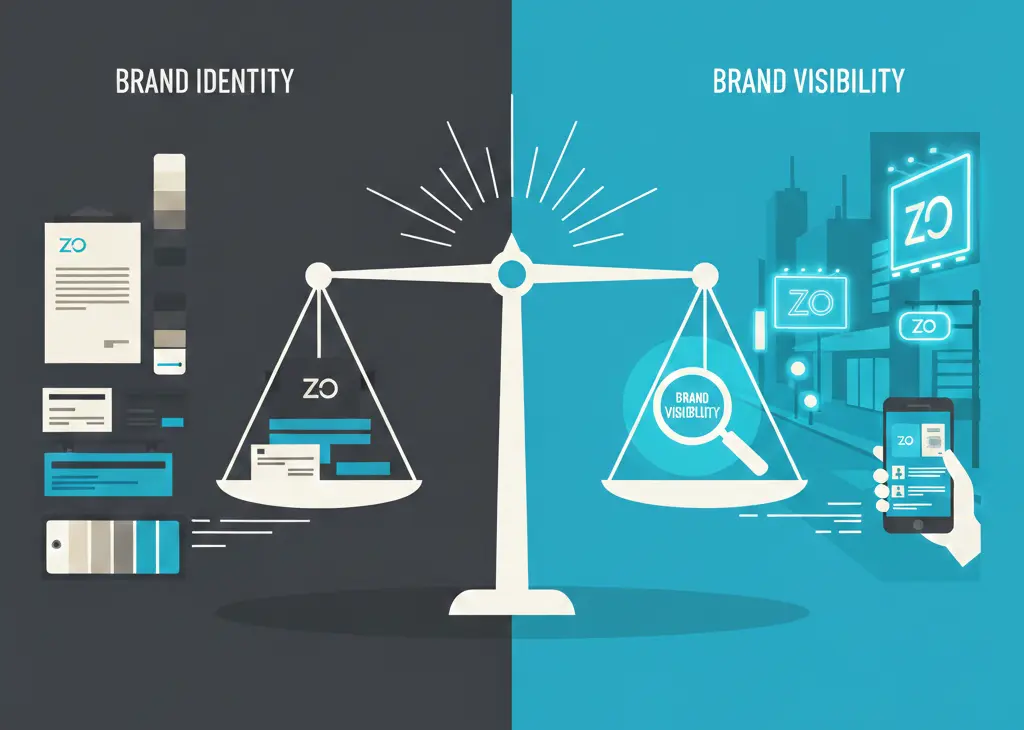
The real power lies in aligning Brand Identity with Brand Visibility. One without the other limits potential.
If you have strong Brand Identity but low visibility, few people will know you exist. If you have high Brand Visibility but weak identity, people will see you but not remember you.
Balance requires strategy.
First, define your Brand Identity clearly:
- Clarify your positioning
- Document your brand voice
- Standardize your visual system
- Align your internal team
Then, scale Brand Visibility strategically:
- Choose the right channels
- Maintain a consistent visual direction
- Measure both awareness and recall
- Optimize based on long term goals
Companies that integrate Brand Identity into every visibility effort achieve stronger returns on marketing investment.
Identity fuels visibility
When Brand Identity is strong, Brand Visibility becomes more effective.
Campaigns become sharper. Messaging becomes clearer. Campaign assets become instantly recognizable. Each impression contributes to cumulative brand equity.
Instead of isolated marketing activities, every touchpoint builds a cohesive narrative.
Identity fuels visibility by giving it direction. Visibility fuels identity by reinforcing it repeatedly.
Together, they create sustainable brand growth.
The financial perspective of brand strategy
From a financial standpoint, balancing Brand Identity and Brand Visibility impacts profitability.
Businesses that invest only in visibility often experience high acquisition costs and low retention. Customers may convert once but fail to return.
In contrast, companies with a strong Brand Identity experience:
- Higher lifetime value
- Lower customer acquisition cost over time
- Greater pricing power
- Stronger referral networks
Strategic brand investment must be aligned with financial planning. Budget allocation between visibility campaigns and identity development requires careful evaluation.
A structured approach to marketing budgets ensures that investments deliver measurable returns. It prevents overspending on visibility while neglecting foundational brand development.
Conclusion
Brand Identity and Brand Visibility are not competitors. They are complementary forces.
Brand Identity defines who you are. Brand Visibility determines how widely you are seen. Visibility without identity creates noise. Identity without visibility limits growth.
The most successful businesses understand that visibility introduces the brand, while identity builds recognition, trust, and loyalty.
If your business is investing heavily in campaigns but struggling with recall or retention, it may be time to reassess your brand foundation. Align your Brand Identity with your Brand Visibility strategy and measure results beyond impressions.
Strong brands are built with clarity. Profitable brands are built with strategy.
Adarsh T S
Digital Marketing Specialist | SEO & Content Strategy | Performance Marketing