Performance marketing has transformed how modern businesses grow. It promises measurable returns, clear attribution, and rapid optimization. For founders and marketing teams under pressure to deliver results, it feels like the most rational investment.
But here is the uncomfortable truth.
Performance marketing does not create demand. It captures it. And without strong branding marketing efforts supporting it, the system eventually weakens. Costs rise. Conversions fall. Ad fatigue sets in. Scaling becomes unpredictable.
Many growing brands mistake early wins for long term stability. In reality, performance marketing without branding is like trying to harvest without planting.
Let us break down why this happens and what it means for sustainable growth.
Performance Marketing Is Built to Capture, Not Create Demand
What performance marketing actually does
Performance marketing focuses on measurable actions. Clicks, leads, purchases, installs. Every campaign is optimized toward a specific outcome. Platforms like Meta and Google are built to identify users already showing signals of intent.
That is the power of performance marketing. It identifies demand that already exists and captures it efficiently.
It works exceptionally well when:
- People already know the category
- There is active search intent
- The brand has some recognition
- The offer is compelling
However, performance marketing is not designed to educate the market from scratch. It does not build deep emotional trust. It does not create brand memory structures. That is where branding marketing plays a crucial role.
Intent capture vs demand creation
There is a major difference between intent capture and demand creation.
Intent capture means reaching users who are already looking for a solution. Demand creation means influencing users before they actively search.
Branding marketing creates demand. It builds familiarity, credibility, and preference over time. When someone finally enters the buying stage, they are not comparing ten unknown options. They are recalling a brand they already trust.
Without branding marketing, performance marketing becomes dependent on transactional behavior alone. And that is a fragile position.
What Breaks When There's No Brand
Low trust, high skepticism
When a user sees an ad from an unknown brand, skepticism is natural.
They ask themselves:
- Is this legitimate?
- Can I trust this company?
- Why have I never heard of them?
If the brand has not invested in branding marketing, there is no familiarity to reduce friction. The user may click, but hesitation increases at the checkout or lead stage.
This is where performance marketing metrics start to deteriorate. Conversion rates drop. Cost per lead increases. Return on ad spend fluctuates.
Trust is not built at the conversion point. It is built before the click.
Ads feel interchangeable
Without a clear brand identity, messaging, and narrative, ads start to look similar to competitors.
In crowded categories, differentiation is everything. If your ads only push discounts and features, your performance marketing becomes a bidding war.
Branding marketing ensures that ads carry distinct visual cues, tone, and positioning. When ads are interchangeable, price becomes the only lever. And that erodes margins quickly.
Clicks Don't Equal Conversions
CTR vs real buying intent
Click through rate often looks impressive in performance dashboards. But a high CTR does not guarantee strong buying intent.
Sometimes curiosity drives clicks. Sometimes the hook is sensational. Sometimes users simply want more information.
Performance marketing can generate traffic efficiently. But if branding marketing has not built authority and clarity, that traffic lacks conviction.
Conviction is what turns interest into commitment.
Post-click drop-offs
Many brands see healthy click numbers but weak on page performance.
Bounce rates increase. Time on site drops. Cart abandonment rises.
This is usually not just a landing page issue. It is a brand perception issue.
When users land on the site and find no cohesive identity, no consistent messaging, and no social proof aligned with the ad, trust breaks. Performance marketing delivered the user. Branding marketing was missing to close the loop.
Rising CPL Is a Brand Signal
The trust tax unknown brands pay
When cost per lead begins to rise, teams often blame audience targeting or platform changes.
But rising CPL is often a signal of weak brand equity.
Unknown brands pay what can be called a trust tax. They must invest more in paid reach to achieve the same level of response as familiar brands.
Branding marketing reduces this tax over time. It builds memory. It builds recall. It builds emotional safety.
The stronger the brand, the lower the resistance during conversion.
Platform efficiency vs brand familiarity
Ad platforms optimize for predicted action. If users are more likely to engage with familiar brands, algorithms reward that behavior.
Performance marketing becomes more efficient when brand familiarity exists.
Branding marketing increases positive engagement signals across channels. That improves relevance scores, lowers costs, and stabilizes results.
Efficiency is not only about targeting. It is about perception.
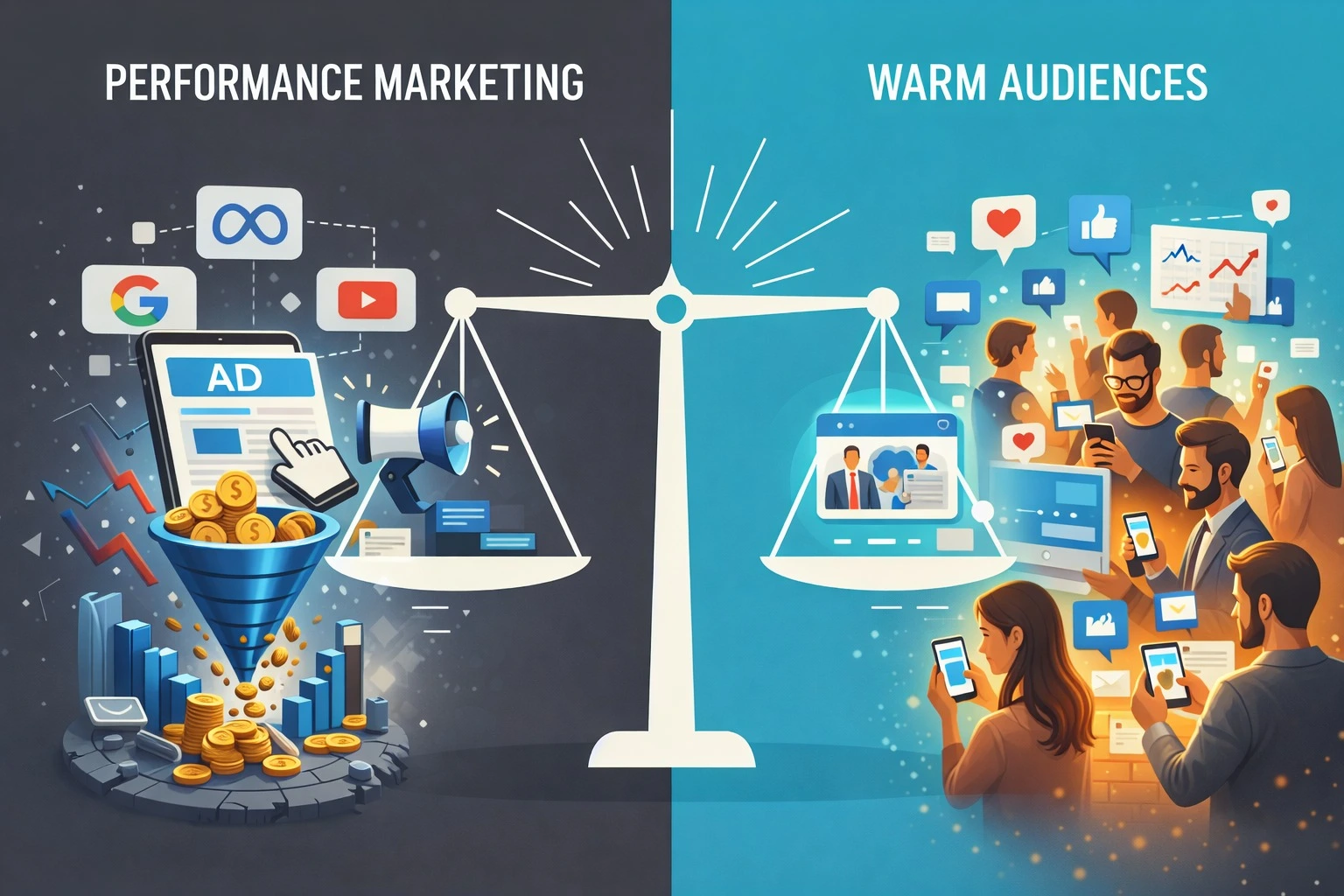
Performance Needs Warm Audiences
Cold traffic economics
Cold audiences are expensive.
When users have never interacted with your brand, conversion probability is lower. You must show more ads, test more ad variations, and accept lower initial returns.
Performance marketing works best when part of the audience is already warm. When users recognize your name, logo, or message, friction decreases.
Branding marketing warms the market before performance campaigns activate it.
Retargeting fails without recall
Retargeting is a core pillar of performance marketing.
But retargeting only works if the user remembers you.
If your brand impression was weak, generic, or forgettable, retargeting feels intrusive rather than persuasive.
Branding marketing ensures that the first touch leaves a strong imprint. That imprint makes retargeting logical instead of annoying.
Brand Is the Hidden Conversion Layer
Familiarity reduces friction
Psychologically, humans prefer familiar choices. Familiarity signals safety.
When branding marketing consistently exposes users to your story, values, and visuals, your brand becomes cognitively easier to process.
That ease translates into higher conversion rates during performance marketing campaigns.
Users do not need to evaluate you from zero. They have seen you before.
Brand cues speed decisions
Strong brands use recognizable cues:
- Consistent colors
- Distinct tone
- Clear positioning
- Memorable taglines
These cues reduce decision making time.
In competitive auctions, speed matters. Performance marketing captures intent at the right moment. Branding marketing ensures that the decision favors you.
Why Ad Testing Stops Working
Fatigue without a narrative
Many teams rely heavily on ad testing to scale performance marketing.
New hooks. New angles. New formats.
But without a strong brand narrative, testing becomes random experimentation.
Users eventually see a stream of disconnected messages. Fatigue sets in faster because there is no cohesive story reinforcing recall.
Branding marketing provides that narrative backbone.
Testing without context
Performance marketing thrives on data. But data without context leads to shallow conclusions.
One ad works this week. Another fails next week. Costs fluctuate.
Without branding marketing anchoring the message, results become inconsistent.
When the brand story is clear, ad testing becomes refinement rather than guesswork.
Short Term ROAS vs Sustainable Scale
Early wins that don't scale
Many brands experience strong early performance marketing results.
Small budgets. High return on ad spend. Quick wins.
Then scaling begins. Budgets increase. Audiences broaden. Results decline.
This happens because early wins often capture low hanging fruit. Warm prospects. Existing demand.
Without branding marketing expanding awareness and shaping perception, scale hits a ceiling.
Stability comes from brand
Sustainable scale requires stability.
Branding marketing builds that stability by:
- Increasing direct traffic
- Improving search demand
- Enhancing referral behavior
- Strengthening repeat purchases
Performance marketing then becomes an amplifier, not the sole engine.
When both systems work together, growth becomes compounding instead of volatile.
Brand × Performance Flywheel
Brand builds belief
Belief precedes action.
Branding marketing shapes how people feel about your company long before they are ready to buy.
It answers deeper questions:
- What does this brand stand for?
- Why should I trust them?
- Are they credible and consistent?
Belief reduces resistance. It improves engagement. It strengthens loyalty.
Performance captures intent
Performance marketing activates that belief at the right moment.
When a user searches, scrolls, or compares options, performance campaigns appear.
But now the brand is not unknown. It is familiar.
That is when performance marketing reaches its true potential. Lower acquisition costs. Higher conversion rates. Better lifetime value.
Branding marketing builds the foundation. Performance marketing accelerates the result.
Together, they create a flywheel where:
- Brand builds awareness
- Performance converts demand
- Satisfied customers reinforce the brand
And the cycle strengthens over time.
Conclusion
Performance marketing is powerful. It delivers clarity, measurement, and speed.
But it is not self sufficient.
Without branding marketing, performance marketing becomes expensive, unstable, and difficult to scale. Rising CPL, inconsistent ROAS, ad fatigue, and weak retention are often symptoms of a deeper issue. Lack of brand equity.
The most successful growth strategies integrate both disciplines.
Branding marketing builds trust, familiarity, and belief. Performance marketing captures intent and drives measurable action.
When brand and performance operate together, results do not just improve. They compound.
If you want predictable, sustainable growth, do not treat branding as optional. It is the invisible engine that makes performance marketing work at its highest potential.
Adarsh T S
Digital Marketing Specialist | SEO & Content Strategy | Performance Marketing