Celebrity brands in India may be moving from the endorsement fee to the founder's stake, and H.I.M is the newest test of that idea. On November 17, 2026, actor Ranveer Singh and Aman Gupta, the boAt co-founder, launched H.I.M (Handsome Indian Man), a men's grooming range of 8 products priced from ₹299 to ₹899, with Singh joining Gupta as a co-founder, according to afaqs and Entrackr.
For anyone who buys creator or celebrity reach, the launch raises a practical question: what do you get when the face owns part of the brand, and what do you give up? This guide sets out the facts of the launch, what Kroll and Tracxn data and recent trade interviews say about celebrity-led brands, how fee, equity and creator-roster deals compare, and what to check before you sign anyone.
Key takeaways
- The model: Singh is a co-founder of H.I.M, a structure Entrackr contrasts with several other celebrity-led personal care brands.
- The value: Kroll puts Ranveer Singh's brand value at USD 162.9 million, second in India, while the top 25 celebrity brands together fell 3.7% to USD 2.0 billion.
- The results: Tracxn data reported by Storyboard18 shows Kay Beauty's FY25 revenue up 50% and 82°E's down 36%, so a famous name alone does not guarantee growth.
- The spend: afaqs reports that ACKO now puts about 80% of its media spend into creators and connected TV, and IPLIX Media's Jag Chima says brands pay 10-30% more for creator exclusivity.
- The rules: India has no dedicated framework for influencer advertising, but disclosure of material connections is expected, and we read an ownership stake as one.
In this guide
- What is Ranveer Singh's H.I.M brand, and why does it matter for influencer marketing?
- How much is a celebrity face worth?
- Do celebrity-founded brands grow?
- Brand ambassador fee, co-founder stake or creator roster: which model fits?
- What can brands learn from H.I.M?
- What do disclosure rules say when a celebrity or creator co-founds the brand?
- How should you plan your next celebrity or creator deal?
- What this means for your next campaign
What is Ranveer Singh's H.I.M brand, and why does it matter for influencer marketing?
H.I.M launched on November 17, 2026 with 8 face, body and hair products priced between ₹299 and ₹899, afaqs reports. The range is built around a proprietary molecule called IN-XT, and it was on sale on the brand's own site, Amazon and Blinkit from day one. The launch film features both co-founders, and Storyboard18 reports that the launch was announced through Singh's own Instagram post carrying the ad. The launch reports do not disclose Singh's shareholding or any fee, so the shift from fee to stake in this post is our reading of the structure.
Gupta brings a second asset, a venture studio. Entrackr reports that his studio, OFF/BEAT, raised a ₹100 crore seed round led by Bessemer in April 2026. It names The Man Company, Ustraa, Beardo, Minimalist and BSC as H.I.M's rivals, and cites IMARC data that puts India's male grooming market at $2.62 billion in 2026 and $4.46 billion by 2034.
The influencer marketing angle is distribution. The launch announcement came through the founder's own account, the same channel creators use when they push their own products. We treat H.I.M as a creator-economy case for that reason, even though Singh is an actor.
How much is a celebrity face worth?

Image: Kroll. Click to read the full report.
Kroll's India Celebrity Brand Valuation 2025, announced in a press release of August 5, 2026, ranks Ranveer Singh second in India at USD 162.9 million. His value was USD 170.7 million in the 2024 edition, where he also ranked second. MS Dhoni is fifth at USD 115.3 million, and the top 25 celebrity brands together are worth USD 2.0 billion, down 3.7%.
The release makes two more points that matter to marketers. By 2025, digital endorsements made up roughly 60% to 75% of brand associations for several leading celebrities, so celebrity reach is now bought on the same platforms creators use. Kroll also cites GroupM ESP's expectation that more celebrities will launch their own brands.
Read together, the release shows celebrity value is large but not rising, and its commentary expects more celebrities to launch brands of their own. We think that explains why a deal like H.I.M now makes sense for the face as well as for the brand.
Do celebrity-founded brands grow?
The record is mixed. Storyboard18, using Tracxn data, compared two celebrity beauty brands in a report published on April 7, 2026:
- Kay Beauty: FY25 revenue up 50% to ₹132 crore, a profit of ₹10.97 crore, and gross merchandise value up from ₹125 crore in FY23 to ₹240 crore in FY25.
- 82°E: revenue down 36% to ₹15.2 crore from ₹23.7 crore, a loss of ₹12.3 crore, and marketing spend cut to ₹4.42 crore from ₹19.65 crore.
The data cannot show why one grew and the other shrank, and the two brands differ in many ways, but the gap is wide enough to say a famous name does not carry a brand alone. 82°E also cut its marketing spend sharply in the same year its revenue fell.
Tarun Sharma, CEO of Hyphen, described the model he sees working as operator-led and celebrity-anchored, in a feature by The Hollywood Reporter India (updated June 18, 2025). His own illustration: a brand with a celebrity might invest ₹30 crore against a ₹100 crore target, while one without might invest about ₹18 crore against a target of ₹80 to 85 crore. This is one operator's example and not audited data. It suggests a celebrity buys faster reach at a higher cost.
Mint reported on October 28, 2026 that creators are following celebrities into launching their own consumer brands, and its summary lists repeat purchases among the main tests. H.I.M has not been on sale long enough to show whether it passes that test, so the first sales and reorder numbers are what to watch over the next few months.
Brand ambassador fee, co-founder stake or creator roster: which model fits?

Image: afaqs. Click to read the full report.
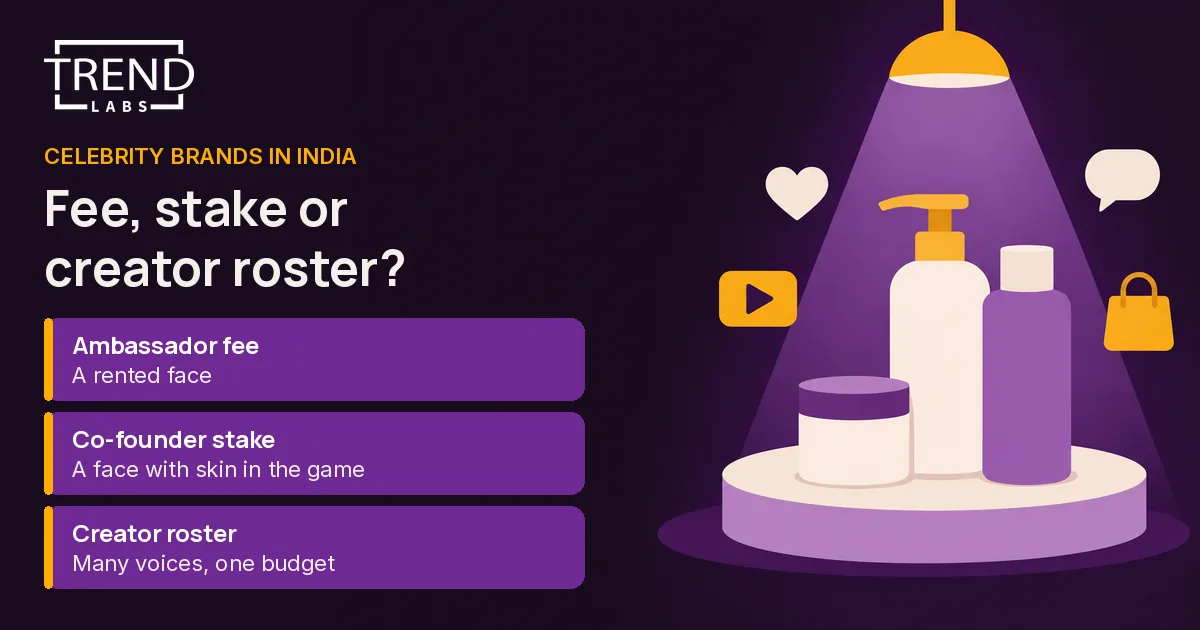
H.I.M puts one model on the table, and recent trade reports describe two others:
- Brand ambassador fee: The brand rents the face. Jag Chima of IPLIX Media told Storyboard18, in a report published on November 17, 2026, that brands pay 10-30% more to keep a creator out of rival campaigns, and that usage rights are negotiated separately. He also defended the usual 20% talent management commission that creators pay their agencies.
- Co-founder stake: The face joins the founding team. Singh says he tested every formulation, afaqs reports, and Gupta calls him one of the most obsessive co-founders he has worked with. afaqs reported on November 13, 2026 that ACKO treats MS Dhoni as an investor as well as a face, which points the same way in insurance.
- Creator roster: Many voices, less reliance on one person. afaqs reports that ACKO has shifted about 80% of its media spend to creators and connected TV over 18 months, and that its last health campaign used no big celebrity faces. Chima says that for a ₹1 crore campaign he would pick creators over film stars.
We think the choice follows what you need. Rent a face for a short burst of reach, share equity when you want the face to act like an owner, and build a creator roster when you need steady, varied content. They also combine: a celebrity-anchored brand can still run most of its media through creators.
What can brands learn from H.I.M?
H.I.M launched on November 17, 2026, so there are no sales results yet. What can be read now is the structure of the deal.
- The founder is a channel: When the face is also a co-founder, their account can carry the launch. That is efficient, and it puts a lot of weight on one person's posting, health and reputation.
- Reach is not repeat purchase: Mint's summary lists repeat purchases among the main tests for creator-led brands, and the Tracxn data suggests star power alone may not turn into sales. Plan how the first purchase becomes a second one.
- Price what you are buying: By Chima's estimate exclusivity can add 10-30% to the fee, and usage rights are negotiated on top, so decide which of them the campaign needs. Our guide to the true cost of customer acquisition shows how to compare that spend with your other channels.
If you are earlier in the process, our guide to wedding season influencer marketing in India covers creator rate cards and how brands judge creators before they pay.
What do disclosure rules say when a celebrity or creator co-founds the brand?
An afaqs guest article published on November 13, 2026 notes that India has no dedicated framework for influencer advertising. In practice, the Advertising Standards Council of India (ASCI) requires disclosure of material connections, and the Central Consumer Protection Authority (CCPA) guidelines cover celebrity and influencer endorsers.
The Department of Consumer Affairs endorsement guide says a material connection includes family, personal or employment relationships, and that the list is not limited to those. It also says endorsers should check that claims can be substantiated and should have used the product.
Our reading is that a founder's financial stake is a material connection, so a co-founder's posts about their own brand should carry a clear disclosure like any paid post. This is general information, not legal advice, so confirm the current rules with your legal team before you brief a face who is also a co-founder of the brand.
How should you plan your next celebrity or creator deal?
A workable order of work, based on the points above:
- Name what you are buying: Decide whether the goal is reach, credibility or ownership of the relationship, then choose fee, equity or roster to match.
- Ask for performance as well as reach: Request recent content results and audience data, and compare the cost per outcome with your other channels.
- Price rights separately: Agree on exclusivity, usage rights and paid amplification as line items, each with a clear term.
- Spread the risk: Keep a roster of creators around any single face so one person's schedule does not stall the plan.
- Plan the second purchase: Decide what happens after launch day, from reviews to repeat offers.
- Disclose every connection: Agree who checks labels on every post, including posts by owners and partners.
What this means for your next campaign
H.I.M points to a possible shift in celebrity marketing, from a fee for a face toward a stake in the outcome. It is too early to say whether it will work, and the Tracxn data shows celebrity brands can grow or shrink. The safer move for most brands is to treat celebrity reach and creator reach as one budget, measure both against the same outcomes, and put disclosure rules in the contract from day one.
If you are weighing a celebrity deal, a creator roster or both, and want a second opinion on structure and measurement from an influencer marketing agency in India, read about our influencer marketing services or book a conversation with the team.
Shreya Shah
Content Strategist at TrendLabs