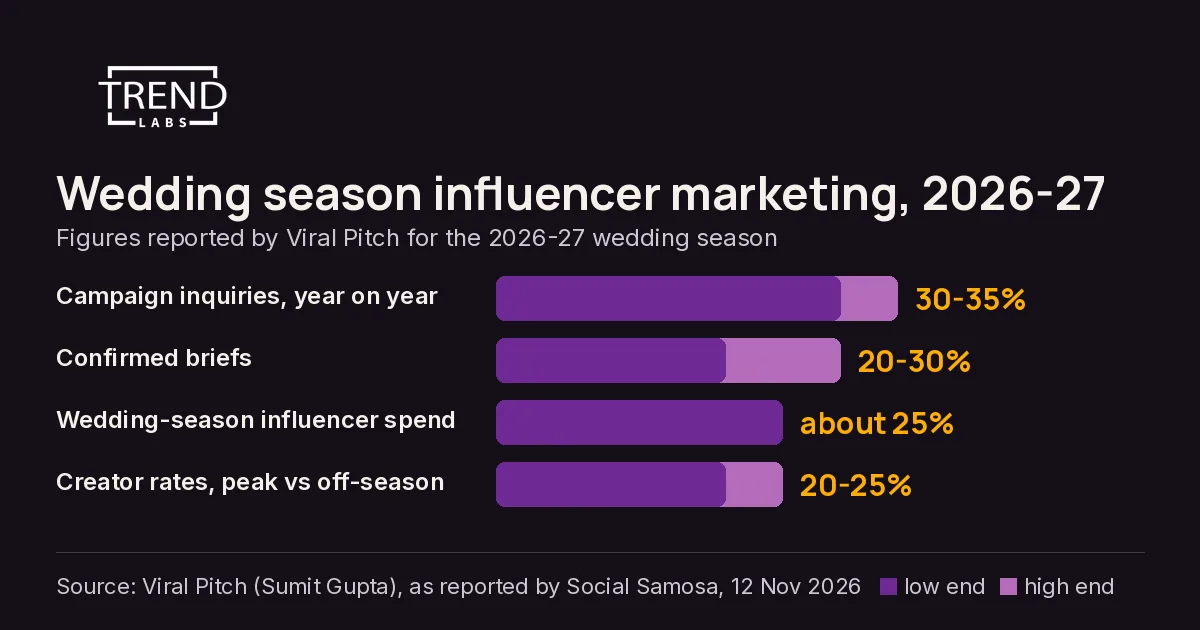
Wedding season influencer marketing in India is getting bigger and pricier in 2026-27, and brands are measuring it more closely. Sumit Gupta, founder and CEO of Viral Pitch, told Social Samosa, in a report published on November 12, 2026, that his agency is seeing campaign inquiries up 30-35% year on year, confirmed briefs up 20-30% and wedding-season influencer spend up about 25%. He also estimates that creator rates can run 20-25% above off-season levels in peak wedding months.
Those figures are one agency's observation, and the report cites no market-wide survey behind them. Other agencies quoted in the same report point the same way: budgets are moving up, creator mixes are widening and brands want proof of relevance before they pay. This guide pulls together the reported numbers, explains what shapes a creator's rate card, and sets out how brands can plan a wedding season campaign without overpaying.
Key takeaways
- Demand: One agency reports inquiries up 30-35% year on year and confirmed briefs up 20-30% for the 2026-27 wedding season.
- Budgets: Emerging D2C and mid-sized brands are reported to spend ₹5-30 lakh per campaign, while large enterprises can spend ₹50 lakh and above.
- Rates: There is no standard rate card, and peak-month creator fees can run 20-25% above off-season levels.
- Mix: Brands are pairing larger creators for visibility with micro and regional creators for targeted reach.
- Proof: Advertisers are asking for audience quality and performance data before signing, and ASCI disclosure rules apply to every post with a material connection, paid or gifted.
In this guide
- What is driving wedding season influencer marketing in 2026-27?
- How much does a wedding season influencer campaign cost in India?
- What are creators charging for wedding season campaigns?
- Which categories and creators are winning wedding season budgets?
- Which content formats are working?
- How are brands judging creators before they pay?
- What do ASCI rules mean for wedding season campaigns?
- Is this only an Indian trend?
- How should brands plan a wedding season campaign?
What is driving wedding season influencer marketing in 2026-27?
Wedding shopping has moved onto social media. Social Samosa describes guests scrolling creator videos for outfits, grooms researching a look and brides building a beauty plan, with creators shaping what shoppers discover, shortlist and buy. That gives brands several entry points into the purchase journey, often well before the first ceremony.
The numbers Gupta shared show how quickly demand is moving:
- Campaign inquiries: up 30-35% year on year.
- Confirmed briefs: up 20-30%.
- Wedding-season influencer spend: up about 25%.
- Creator rates: 20-25% above off-season levels in peak wedding months.
Jag Chima, co-founder at IPLIX Media and Sarkar, says the bigger change is where influencers sit in the plan. Heritage jewelers and large retailers, he says, are now bringing creators into plans that used to center on television, print and retail, while digital-first beauty, occasion wear and D2C jewelry brands often treat creators as a central part of the wedding plan.
How much does a wedding season influencer campaign cost in India?
There is no single budget, but the agencies quoted by Social Samosa give useful bands. Gupta puts typical spend for emerging direct-to-consumer (D2C) and mid-sized brands at ₹5-30 lakh per campaign, with larger enterprises spending upwards of ₹50 lakh. Anindita Lal, vice president and head of strategy at Qoruz, says a regional campaign could run into a few lakhs, while campaigns across several creator categories, languages and markets can move into ₹50 lakh to ₹1 crore or more.
Share of the media plan is another yardstick. Yogesh Bajpai, business head at Dot Media, says influencer marketing can take around 20-30% of a brand's wedding-season media budget, though it varies across campaigns.
Lal also cautions against reading size as quality. A ₹50 lakh campaign is not necessarily more effective than a ₹10 lakh one, she says, because it depends on whether the brand is buying mass visibility, regional relevance or a specific consumer action. A practical reading: decide which of those three outcomes the season is for before choosing a budget band, because a brand chasing regional relevance and a brand chasing conversions should not brief creators the same way.
What are creators charging for wedding season campaigns?
Social Samosa reports that influencer marketing has no universally accepted rate card, so quotes vary widely. Chima offers indicative ranges: nano and micro creators charge a few thousand to tens of thousands of rupees per Reel, mid-tier creators around ₹50,000 to the low lakhs, and top creators several lakhs and upwards. They are one agency's indicative ranges, and a creator's audience, performance and campaign scope can change the final quote.
Several factors move the final quote:
- Audience quality and engagement: Lal says follower count alone cannot establish a creator's market value.
- Content format: Lal says Stories and static posts are generally priced lower than Reels, while dedicated YouTube videos and larger productions tend to command higher fees.
- Production needs: Social Samosa notes that wedding-related fashion, beauty and luxury content can involve extra styling, locations and production.
- Scope: A campaign with an event appearance is not commercially equivalent to a single Reel, the report says.
- Rights: Permission to reuse content in paid advertisements can raise the fee, the report adds, and Chima says exclusivity and category restrictions can too.
Chima's point is that when creator fees, production, usage rights and paid amplification are planned together, one partnership can support content across social, digital and retail. That argues for agreeing on rights up front instead of negotiating them after the content is made.
Why do rates climb in peak wedding months?
With more brands competing for relevant creators, demand pushes fees up. Gupta estimates that rates can rise 20-25% over off-season levels during peak wedding months, as premium posting slots become limited. We think booking earlier is the simplest way to avoid competing for those slots.
Which categories and creators are winning wedding season budgets?
Jewelry, bridal and ethnic fashion, beauty, skincare and grooming remain the natural fits, Social Samosa reports. The opportunity is wider than the bride, though. Lal points to beauty and personal care, travel, gifting, consumer electronics and even financial services, because a wedding is a network of people making different purchases around the same occasion. Agencies also named fragrances, premium FMCG, food, hospitality, lifestyle products and home decor.
So more kinds of brands have a reason to take part. Chima notes that parents, siblings, friends and guests are all shopping, traveling and gifting, which opens room well beyond bridal content. Social Samosa's examples: a grooming brand can speak to the groom's routine, a fragrance brand can tap into gifting, and travel companies can target guests or couples planning trips.
Why are regional and micro creators gaining ground?
Weddings differ by community. Chima gives the example of Punjabi, Marwari and Tamil weddings, which each bring distinct customs and preferences, and says content feels real when it comes from a genuine cultural insider. Gupta says brands are bringing micro-influencers and regional creators from Tier 2 and Tier 3 cities into the mix beyond celebrity and macro creators, and Bajpai adds that regional and micro creators offer more targeted reach at a lower cost. Budgets are being split accordingly, with larger creators bought for visibility and smaller ones for relevance.
Which content formats are working?
Gupta points to day-in-the-life videos, get-ready-with-me (GRWM) formats and behind-the-scenes wedding content. These let a product appear inside routines audiences already follow, such as preparing for a ceremony, choosing an outfit or documenting the celebrations. Social Samosa's reporting also notes that brands are moving away from relying only on scripted promotions.
How are brands judging creators before they pay?
Follower counts matter less than they did. Lal puts the question this way: a creator may have a million followers, but how many are genuine, how many are relevant to the brand, and how consistently does the content perform? She says better data makes it easier to assess audience authenticity, content performance and relevance.
The same pressure shows up outside India. Digiday reported on November 9, 2026 that advertisers are asking creators for cost per lead, cost per conversion and earned media value, and that some brands want Instagram link clicks and engaged YouTube views up front. The agency HYDP, quoted there, reviews a creator's content over a 30-day window and leaves out viral content when setting expectations.
For wedding season, that suggests asking each shortlisted creator for recent performance data and audience location before agreeing on a fee. Tying those results to your own acquisition math, as in our guide to the true cost of customer acquisition, keeps influencer spend comparable with your other channels.
What do ASCI rules mean for wedding season campaigns?
The Advertising Standards Council of India (ASCI) requires a disclosure label on any influencer advertisement where there is a material connection with the brand. Under its influencer guidelines, a material connection is not limited to money: free or discounted products and other perks count too. The label must be upfront and prominent, not buried among hashtags, and responsibility sits with both the advertiser and the influencer.
Permitted labels include Ad, Sponsored, Collaboration, Free gift, Affiliate, the Paid Partnership tag on Instagram and the Includes Paid Promotion tag on YouTube. For videos of 15 seconds or less, the label must stay on screen for at least 3 seconds. For videos between 15 seconds and 2 minutes it should stay for one third of the video, and for videos of 2 minutes or more it must stay for the entire section where the brand is mentioned.
Financial services, one of the categories Lal names, carries an extra step. ASCI's guidelines say influencers giving stock or investment advice should be registered with SEBI and state their registration number. This is general information, not legal advice, so check the current guidelines with your legal team before briefing creators.
Is this only an Indian trend?
No. The Interactive Advertising Bureau (IAB) projected in its 2025 creator economy report that US creator ad spend would reach $37 billion in 2025, up 26% year on year and nearly four times faster than the media industry overall, and it expects about $44 billion in 2026. Those figures cover the US market, so they show direction only and say nothing about Indian budgets.
How should brands plan a wedding season campaign?
Pulling the reported points together, this is a sensible order of work:
- Set one outcome per campaign: Decide whether the aim is mass visibility, regional relevance or a specific consumer action, then match the budget band and creator mix to it.
- Book early: Agencies report brands are planning earlier, and premium posting slots become limited at peak.
- Price the rights up front: Agree on usage rights, paid amplification and exclusivity in the same negotiation as the fee.
- Mix tiers and regions: Pair larger creators for reach with micro and regional creators for cultural context.
- Look past followers: Ask for audience quality, engagement and recent performance data before you pay.
- Label every post with a material connection: Follow ASCI disclosure rules and agree who checks them.
What this means for your wedding season plan
The reported numbers all point to a busier and more expensive season. They also come from a small group of agencies, so treat them as indicators and check them against quotes for your own category and cities. Before you book, decide what a good outcome looks like, price rights and production together, and judge creators on audience fit and recent results.
If you are planning influencer campaigns for the 2026-27 wedding season and want a second opinion on creator mix, budget split and measurement, read about our influencer marketing services or book a conversation with the team.
Shreya Shah
Content Strategist at TrendLabs