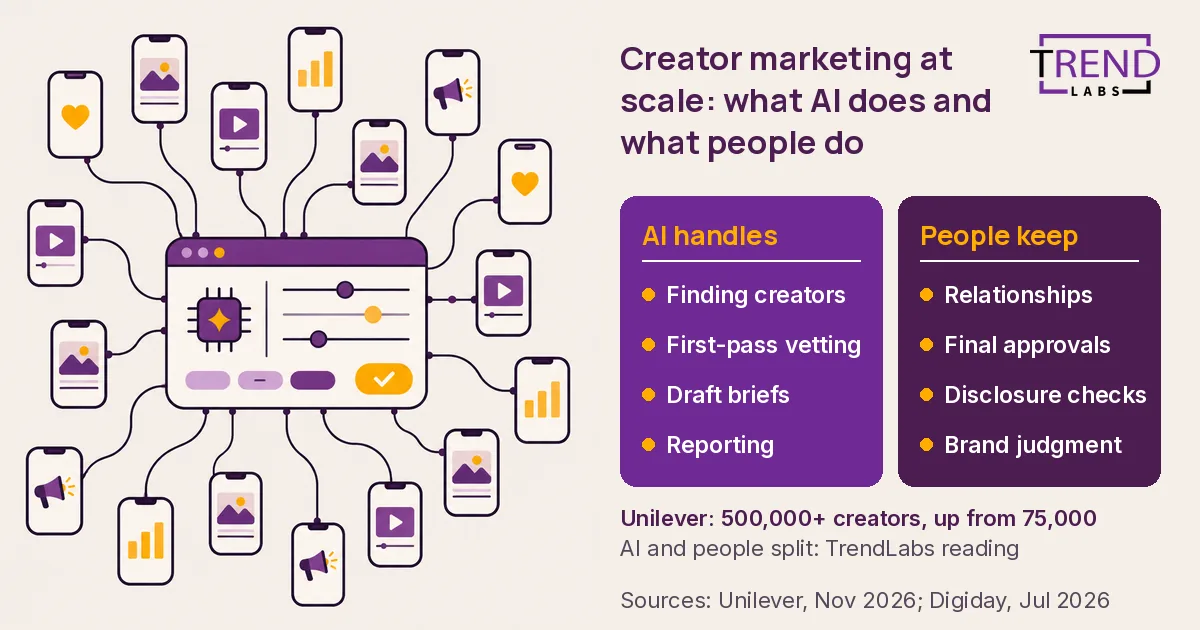
Creator marketing at scale means running hundreds or thousands of creator partnerships as one system, with software handling the repetitive work and people handling the relationships. Unilever now describes its marketing this way. For an Indian brand, the lesson is to automate discovery, vetting, briefing and reporting, and to keep relationships, approvals and brand judgment with people.
Unilever presented its Desire at Scale model at an investor event in New York on November 4, 2026, and published the figures on November 16. Indian trade coverage followed on November 18. This guide sets out what Unilever and its Indian arm, Hindustan Unilever (HUL), report, what AI does in the model, what to automate, and how we use automation at TrendLabs. Every Unilever, HUL and TrendLabs figure here is a company figure, not an independent audit. If you want a partner for your own creator program, see our influencer marketing services.
Key takeaways
- The scale: Unilever says it works with more than 500,000 creators, up from 75,000 in 2024, and that creator content returns about 1.5 times what brand content does.
- India: HUL's chief executive said the company reaches 30,000 creators in India. Its annual report for fiscal 2024-25 put the network at more than 12,000, up from 700.
- The AI role: Unilever says AI helps it find, brief, vet and measure creators, and that it makes 12 times more content than in 2024 at 90% lower cost.
- The split: Automate the repeatable work. Keep relationships, final approvals and disclosure checks with people.
- The rules: ASCI puts disclosure responsibility on both the advertiser and the influencer, and has extra rules for virtual influencers.
In this guide
- What did Unilever report about creator marketing?
- What does this mean for influencer marketing in India?
- How is AI changing influencer marketing?
- What should a brand automate, and what should people keep?
- How do we use automation at TrendLabs?
- What are the limits of the creator-at-scale model?
- What this means for your next campaign
- Frequently asked questions
What did Unilever report about creator marketing?
Image: exchange4media. Click to read the full report.
Leandro Barreto, Unilever's chief marketing officer, presented what the company calls Desire at Scale. Unilever's write-up describes a social-first demand model with four capabilities: recommendation at scale, content at scale, influence at scale and media at scale. Marketing Dive reported on November 12, 2026 that Unilever plans to shift half of its digital ad spend to social-first and creator-driven marketing. On media, Unilever says proprietary technology across more than 40 retailers and 20 markets improved return on investment by about 10% on average.
On influence, Unilever says it now works with more than 500,000 creators, up from 75,000 in 2024. It also says creator content delivers around 1.5 times the return of brand content, as exchange4media reported on November 18, 2026. That is Unilever's own measurement and the 500,000 is a company-wide count across its top markets. Unilever gives one example of scale: for the FIFA World Cup 2026 it says it worked across 120 markets, with more than 100,000 pieces of content and 50,000 creators.
What does this mean for influencer marketing in India?
Priya Nair, chief executive and managing director of HUL, said at the same investor event that HUL reaches 30,000 creators in India and will double down on creator marketing. HUL's own history shows how fast that grew. Its annual report for fiscal 2024-25, as exchange4media reported on July 1, 2025, said the network had grown from 700 creators to more than 12,000, working with more than 50 brands across 15 categories.
Put together, that is roughly 700 creators, then more than 12,000, then 30,000. The three numbers come from different documents and may not count creators the same way, so the exact growth rate is uncertain.
Unilever's AI-answer data also names India. It says Dove is the most-mentioned brand in AI answers for deodorants and skin cleansing in both the US and India. Unilever files this tracking under recommendation at scale, one of its four capabilities, next to influence at scale.
On cost, Storyboard18 reported on November 20, 2026 that influencer fees in India are not falling, but brands now ask for more deliverables for the money and judge engagement quality, audience relevance and campaign performance. The same report says niche creators keep their pricing power and that a hybrid of a guaranteed fee plus a performance incentive may emerge. Our guide to affiliate influencer marketing in India covers one way to tie pay to results.
How is AI changing influencer marketing?
Unilever and Snap point to four places where AI in influencer marketing is already at work.
Finding, vetting, briefing and measuring creators
Marketing Dive reported that Unilever uses AI to find, brief, vet and measure creators. Digiday reported in July 2026 that AI agents can produce a list of brand-appropriate creators within minutes and flag past controversies, and its headline summed up Unilever's approach as automating everything except the relationship.
Making content versions faster
Unilever says it has codified what makes each brand distinctive into an AI-powered content engine. A video that took three weeks now takes three hours, according to Barreto as quoted by exchange4media. Unilever says it makes 12 times more content than in 2024 at 90% lower cost, and that the content is performing better too. Marketing Dive reported that Unilever puts the lifespan of video on major platforms at about four days before returns turn negative, and says its return on content improves 10% to 15% a year.
Tracking what AI answer engines say about the brand
Unilever says it tracks more than a million AI prompts every week. In the last six months, it says, 91% of the brand-market positions it tracks improved their ranking in AI search results. To feed those answers, it says it has structured 150,000 scientific documents so machines can read its product claims. These are Unilever's own figures.
Snap Creator Network: AI-led discovery on a platform
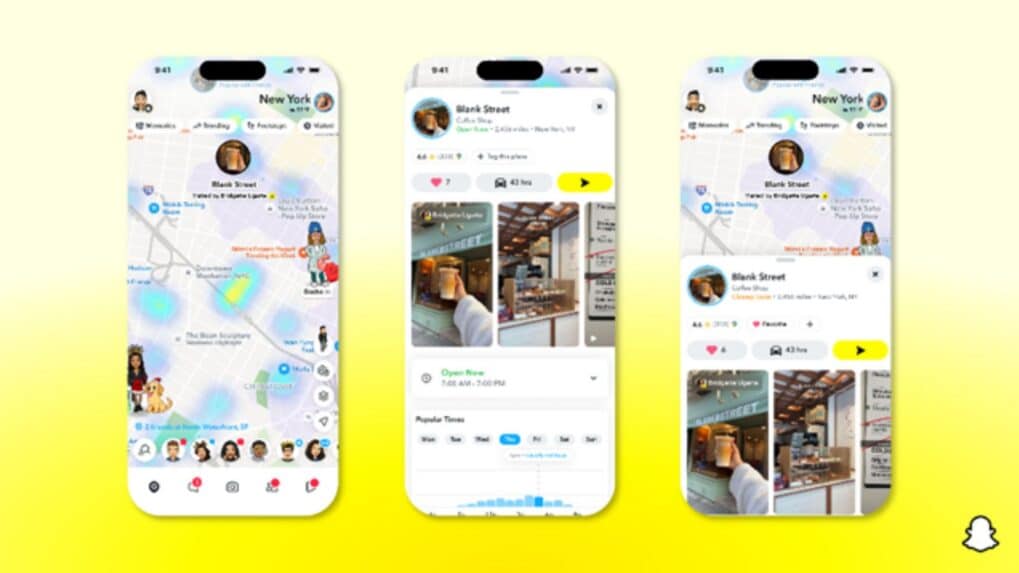
Image: Storyboard18. Click to read the full report.
Platforms are building the same tools. Storyboard18 reported on November 19, 2026 that Snap has opened an AI-powered Creator Network in open beta. Advertisers can search creators by audience profile, content category and campaign objectives, assess performance, build shortlists and start conversations. A companion feature, Visited By, links creator posts to places on Snap Map, which the report says has more than 450 million monthly visitors. The Creator Agency Partner Program launched in the US, UK and the Middle East and North Africa, with more regions planned. No India date has been announced.
What should a brand automate, and what should people keep?
This split is our reading of the sources above, not a result from a campaign. Unilever's own summary is that technology gives it scale and culture gives it meaning.
- Automate discovery and shortlisting: Unilever says AI helps it find creators, and Snap's tool searches by audience, category and objective.
- Automate first-pass vetting: Flagging past controversies is quick work for software. A person still decides who gets a contract.
- Automate briefs and content versions: Draft the briefs and the versions of approved content faster, and have a person approve every one.
- Automate reporting: Collect reach, cost and sales in one place, because brands now judge creators on campaign performance.
- Keep relationships with people: Unilever says its people stay in charge of the creator relationships.
- Keep approvals and disclosure with people: ASCI says responsibility for disclosure sits with both the advertiser and the influencer. Our wedding season guide lists the label wording it accepts.
How do we use automation at TrendLabs?
We use automation in our own work too, with a person overseeing the critical steps. TrendLabs has designed an in-house automation agent for SEO and social media marketing. The SEO side handles content research, technical SEO and link building, among other tasks, and it runs on an SEO framework we curated, which we see as its moat.
By our own figures, work that took about three months by hand can now be done in 10 days, and clients save more than 80% of the time. Consistency of delivery has also improved considerably. Clients get an SEO tracker dashboard where work and progress are explained in plain English, so they can see where things stand.
One part of the agent automates blogging, and this blog is produced that way. A person still oversees code deployment, final publishing and other critical tasks, because an AI tool can make the occasional costly mistake. Our single SEO plan costs ₹40,000 a month. Our SEO services page describes what the work covers.
What are the limits of the creator-at-scale model?
The numbers are company figures. Digiday reported on March 23, 2026 that Unilever had not published progress against the target it set in March 2025, that many brands lack systems to measure creator spend and results, and quoted Agentio chief executive Arthur Leopold as saying that chasing volume has led to a lot of spray and pray with micro and nano influencers.
The 500,000 is Unilever's count across its top markets, and HUL's figure for India is 30,000. Snap's agency program is not announced for India. On disclosure, the Advertising Standards Council of India (ASCI) says in its influencer advertising guidelines that disclosure responsibility sits with both advertiser and influencer, that virtual influencers must also disclose that people are not interacting with a real human, and that health and finance influencers must show their qualifications upfront. This is general information, not legal advice, so confirm current rules with your legal team.
What this means for your next campaign
The evidence says creator marketing at scale runs as a system. Unilever and HUL show the direction, and the Digiday and Snap reports show where AI helps today. For most Indian brands, the practical move is to pilot AI on discovery, vetting, briefs and reporting with a small group of creators, measure what it saves, and keep people on relationships, approvals and disclosure. A pilot can be small: pick one product line and a small group of creators, use AI for discovery, vetting and reporting on one campaign, compare the hours spent and the cost per result with your last campaign, and extend only what saves time without hurting quality.
If you want a second opinion on how to scale a creator program, talk to an influencer marketing agency in India that runs these campaigns. See our influencer marketing services or book a conversation with the team.
Frequently asked questions
What is creator marketing?
Creator marketing is the practice of working with creators to make and share content for a brand. It overlaps with influencer marketing, and the two terms are often used interchangeably. Unilever, which calls its approach creator-led marketing, treats influence at scale as one of four capabilities in its social-first demand model, next to recommendation, content and media.
How many creators does Unilever work with?
Unilever says it works with more than 500,000 creators worldwide, up from 75,000 in 2024, and that creator content returns about 1.5 times what brand content does. Both are company figures published on November 16, 2026, and neither is independently audited. In India, Hindustan Unilever says it reaches 30,000 creators.
Can AI find and vet influencers?
In part. Unilever says AI helps it find, brief, vet and measure creators, and Digiday reported that AI agents can produce a list of brand-appropriate creators within minutes and flag past controversies. People still make the final choice and manage the relationship. Snap has also opened an AI creator discovery tool in beta, with no India date announced.
Do virtual influencer posts need a disclosure in India?
ASCI's influencer guidelines say responsibility for disclosure rests with both the advertiser and the influencer. Virtual or computer-generated influencers must also disclose that people are not interacting with a real human. This is general information, not legal advice, so confirm current rules with your legal team before you publish a campaign.
What should brands automate in a creator program?
Start with repeatable work: finding and shortlisting creators, first-pass vetting, draft briefs and performance reporting. Keep relationships, final approvals and disclosure checks with people. This split is our reading of Unilever's approach and the Digiday and Snap reports, not a campaign result, so test it on a small group of creators first.
Shreya Shah
Content Strategist at TrendLabs