The creator economy is worth about $116 billion in marketer spending in 2026, and India is the fastest-growing market, at 20 percent growth against 15 percent worldwide. That is the estimate of the research firm Madison & Wall in a report it published on November 18. The largest slice, 44 percent, pays to run ads behind creator content, and the fastest-growing slice pays creators to make ads. For an Indian brand planning 2027, the practical lesson is to budget creators as three separate lines: their audience, paid reach behind their content, and content made for your own ads.
Madison & Wall was founded by Brian Wieser, the former global president of business intelligence at GroupM, Net Influencer reported. The Madison & Wall figures are research estimates and the Indian figures come from other sources with a different scope, so we flag which is which. If you want a partner for your own program, see our influencer marketing services.
Key takeaways
- The size: Madison & Wall estimates marketer spending on creators at $116 billion in 2026, up 15 percent from $101 billion in 2025, and $178 billion by 2030.
- India: The report puts India's 2026 growth at 20 percent, the fastest of the markets it lists, from a base of about 1 percent of global creator spending in 2025.
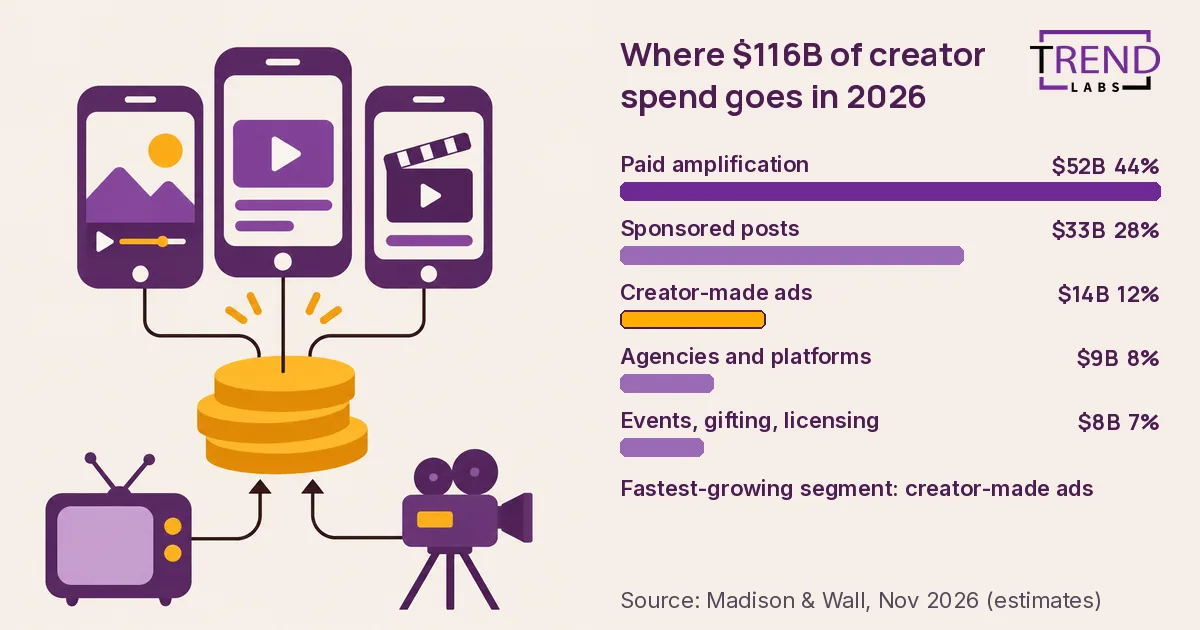
- The split: Paid amplification takes 44 percent, sponsored posts 28 percent and creator-made ads 12 percent, the fastest-growing segment.
- The funding: The report says the money mostly comes from TV, performance media and ad production budgets, not new money.
- The 2027 move: Name the job of each creator line, price usage rights and paid reach when you book, and ask for deduplicated reach before you scale.
In this guide
- How big is the creator economy in 2026?
- Why is India the fastest-growing creator economy?
- Where does the creator money go?
- Where are brands finding the budget?
- What is changing for influencer marketing in India?
- How should a brand plan its 2027 creator budget?
- What do these numbers not tell you?
- What this means for your 2027 plan
- Frequently asked questions
How big is the creator economy in 2026?
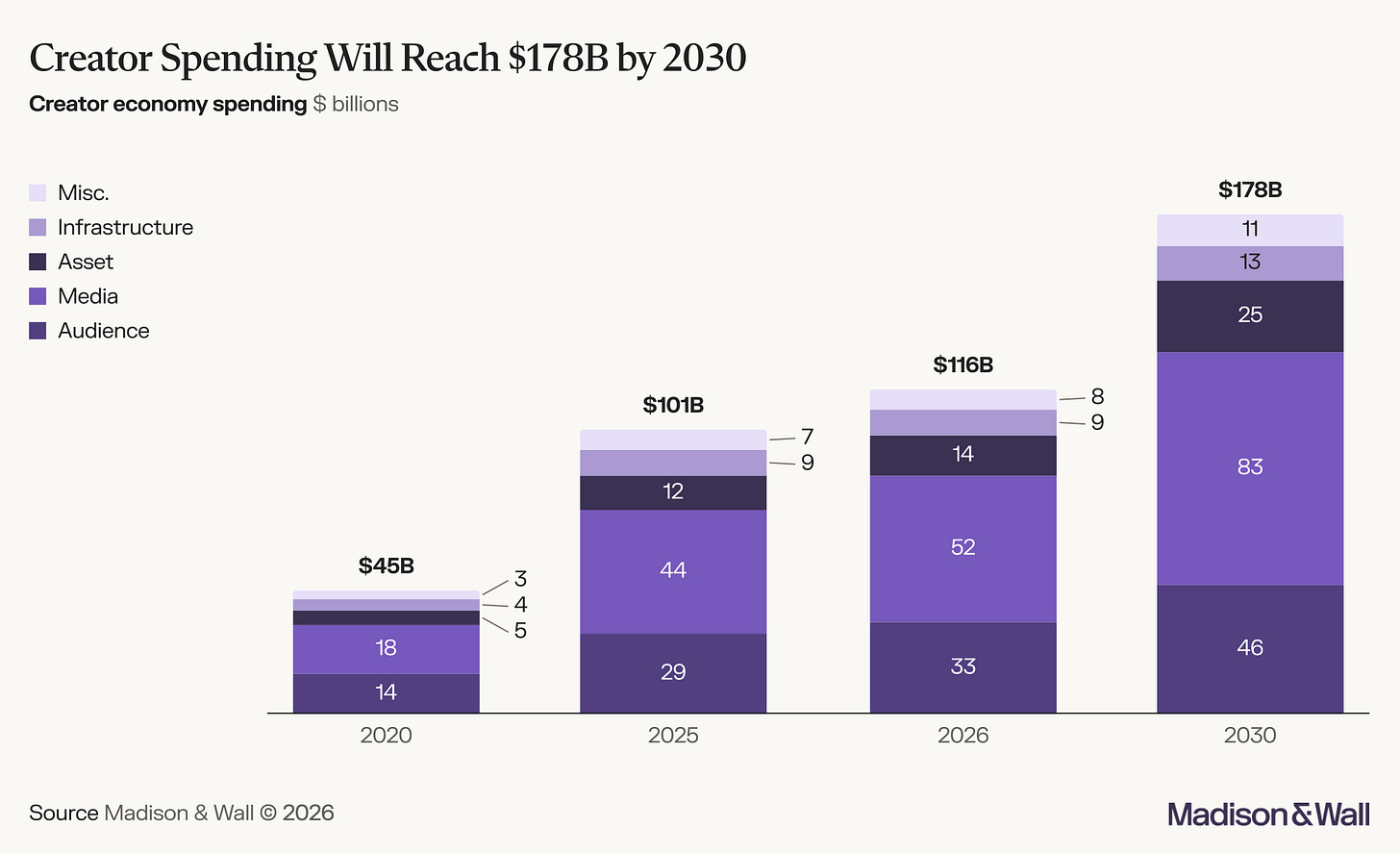
Image: Madison & Wall. Click to read the full report.
Madison & Wall's report, titled Following the Money, estimates that marketers will spend $116 billion on creators in 2026. That is a 15 percent rise from $101 billion in 2025, and the firm forecasts $178 billion by 2030. Creator spending grew about 18 percent a year from 2020 to 2025, against 12 percent for advertising overall, and the report expects 12 percent a year to 2030 against 6 percent for advertising.
The report counts only what marketers spend on creator-related activity. It leaves out fan subscriptions, tips, merchandise and platform payouts to creators, and every dollar sits in one of five segments. Other estimates use a wider definition: Net Influencer noted that Goldman Sachs put the broad creator economy at about $250 billion in 2023, which includes platform payouts and fan money. Digiday and Marketing Dive both covered the report on November 18. Check what each total counts before comparing two reports.
Why is India the fastest-growing creator economy?
The report forecasts 2026 growth of 20 percent for India. The rest of its list: 16 percent for the rest of the world, 15 percent for the US and Brazil, 14 percent for the UK and Australia, 13 percent for Canada and France, and 12 percent for Germany. It credits India's pace to strong economic growth and an expanding advertising market. India is also a small base: about 1 percent of global creator spending in 2025, against 43 percent for the US.
Indian estimates measure something else.
- EY India: A 2024 EY report sized influencer marketing in India at Rs 2,344 crore for 2024 and forecast Rs 3,375 crore by 2026, an 18 percent annual rate. EY's survey ran in September and October 2023, so the 2026 number is an older forecast.
- Kofluence: The influencer platform's Decoding Influence 2026 report, covered by ET BrandEquity on May 14, valued influencer marketing at Rs 3,000 to 3,500 crore in 2025 and projected Rs 4,500 to 5,000 crore by 2027. It is one platform's view.
The EY and Kofluence numbers size influencer fees and campaigns in India. Madison & Wall counts what marketers spend, including the paid media that runs behind creator content. That is why you should not set a rupee figure from one next to a dollar figure from the other, and why we do not convert India's 1 percent share into rupees.
Where does the creator money go?
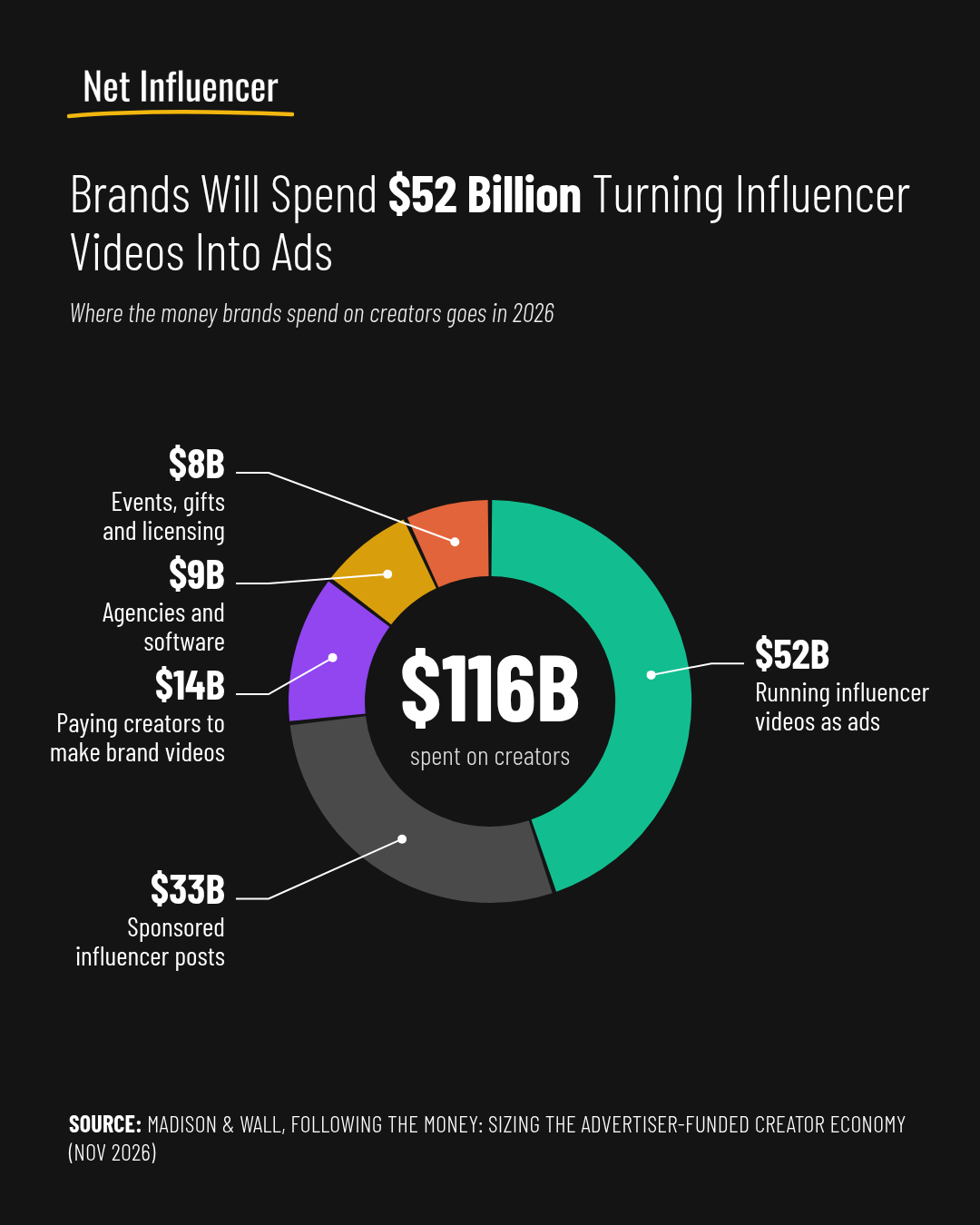
Image: Net Influencer. Click to read the full report.
The report splits 2026 creator spending into five segments, with no overlap. Percentages are rounded.
- Paid amplification (media-led), 44 percent or $52 billion: boosting creator posts, running creator content as paid social ads, partnership ads and the media cost behind them.
- Sponsored posts (audience-led), 28 percent or $33 billion: posts and ambassador deals that rely on the creator's own audience.
- Creator-made ads (asset-led), 12 percent or $14 billion: brands pay for the content itself rather than reach. The report calls this the fastest-growing segment, at about 16 percent a year to 2030.
- Agencies and platforms (infrastructure), 8 percent or $9 billion: the net revenue kept by agencies, talent managers and technology platforms.
- Events, gifting and licensing (miscellaneous), 7 percent or $8 billion.
The largest bucket includes the full media cost, which the report says expands the total significantly, so a big share of the $116 billion is media budget that now carries a creator's face. Creator-made ads are often called UGC ads. Madison & Wall's Luke Stillman told Digiday that brands do it because it is cheaper.
Where are brands finding the budget?
The report says the money is mostly reallocated, not new. It comes from traditional media, notably TV, from digital performance media such as paid social, programmatic and search, and from ad production budgets. An executive at a tech-enabled influencer marketing company told the researchers that "80% of the time we are cannibalizing another budget", a line Tubefilter also quoted. The report does not name the executive.
For digitally native and direct-to-consumer brands, the contest is often inside social: the media budget has not gone away, only what goes into the ads has changed. Our guide to creator marketing at scale and Unilever's 500,000 creators covers how one of the largest advertisers runs creators as a system.
What is changing for influencer marketing in India?
Image: exchange4media. Click to read the full report.
Indian trade coverage this week points the same way as the global report. IMPACT's November 23 cover story quotes Diwaker Chandani of Influential India, part of Publicis Groupe India, saying influencer marketing is moving from experimental to a planned, always-on line item inside overall media spends. Deleise Ross, head of business at Mudra, said the shift has happened in the back office and not on the plan, because creator budgets are often approved after the media plan is signed.
Measurement is the gap
Ross also raised a measurement problem. With 40 creators, she said, a brand cannot tell whether it reached 40 million people once or 8 million people five times. She called for independent audience measurement, deduplication across creators and a standard trading unit. Syed Sibtain Imam of Honasa Consumer told IMPACT the shift is from measuring activity to measuring contribution.
Creator media and usage rights
exchange4media reported on November 24 that India's influencer agency scene is seeing an explosion of new players, helped by low entry barriers. Vikas Chawla, co-founder of Social Beat, said brands should find creator content that already performs organically and amplify it through partnership ads, which he calls creator media. He expects pricing to move toward usage rights and outcomes and away from fixed per-post rate cards. He also warned that two creators with similar subscriber counts, such as a Tamil cooking creator and a Hindi creator, may share little audience.
Storyboard18 reported on November 20 that influencer fees are not falling, but brands are demanding more deliverables and judging engagement quality, audience relevance and performance. It says niche creators keep their pricing power and a hybrid of a guaranteed fee plus a performance incentive may emerge. Our guide to affiliate influencer marketing in India covers how to structure that hybrid.
What are partnership ads?
Partnership ads, according to Meta's help center, let a business run ads with partners, including creators. The partner account, the advertiser account or both appear in the ad header, and the ads use signals from both accounts. Meta says they can now run in the WhatsApp Status placement as well, from September 2026. Eligible accounts are Facebook Pages or profiles in professional mode and Instagram professional accounts.
How should a brand plan its 2027 creator budget?
The report gives no ideal split for a brand, so the checklist below is our reading of the sources above, not a tested formula.
- Name the job of each line: reach through a creator's audience, paid reach behind their content, or content made for your own ads. Each is bought and judged differently.
- Price usage rights and paid reach at booking: if pricing is moving toward usage rights, as Chawla expects, a flat post fee leaves usage rights unpriced.
- Choose creators for audience fit and language: follower counts say little when two creators with the same numbers reach different people.
- Ask for deduplicated reach before you scale: if an agency cannot say how many unique people 40 creators reached, scale slowly.
- Measure contribution: track sales, leads or sign-ups per creator line, not posts delivered.
- Check who benefits from the creator count: exchange4media quotes Swati Nathani of Team Pumpkin saying agency revenue often grows with the number of creators booked, so there is little reason to recommend fewer. Ask who is paid to say no.
- Disclose every paid post: the Advertising Standards Council of India (ASCI) requires a disclosure label whenever there is a material connection, placed upfront and not buried in hashtags. Our wedding season guide lists the label wording.
What do these numbers not tell you?
The $116 billion is a research firm's estimate, not audited spend, and India's 20 percent is a forecast for 2026. The first bucket counts media inventory, so it is larger than what creators themselves earn. India's 1 percent share is rounded, and EY's rupee figure comes from a 2023 survey. Madison & Wall says a second part of its study will look at inconsistent pricing, slow contracting and limited measurement, so the picture is not complete yet.
What this means for your 2027 plan
Creator spending is now a media decision, and India is growing faster than any other market in the report, though from a small base. Decide which of the three jobs you are buying, price usage rights and paid reach when you book, and ask your agency for deduplicated reach before you add creators.
If you want a second opinion on how to plan a creator budget, talk to an influencer marketing agency in India that runs these campaigns. See our influencer marketing services or book a conversation with the team.
Frequently asked questions
How big is the creator economy in 2026?
Madison & Wall estimates that marketers will spend $116 billion on creators in 2026, up 15 percent from $101 billion in 2025, and $178 billion by 2030. The figure counts marketer spending only, including the paid media behind creator content, and leaves out fan subscriptions, tips, merchandise and platform payouts. It is a research estimate, not audited spend.
Why is India's creator economy growing fastest?
Madison & Wall forecasts 20 percent growth for India in 2026, against 15 percent globally, and credits strong economic growth and an expanding advertising market. India held about 1 percent of global creator spending in 2025, so the rate comes from a small base. Treat it as a forecast, not a result.
What are partnership ads?
Partnership ads, according to Meta, let a business run ads with partners such as creators. The partner account, the advertiser account or both appear in the ad header, and the ads use signals from both accounts. Meta says they can also run in the WhatsApp Status placement since September 2026. Disclosure rules still apply.
What is the difference between influencer marketing and UGC ads?
Influencer marketing usually pays a creator to post to their own audience, which Madison & Wall calls audience-led spending. UGC ads, or creator-made ads, pay for the content itself rather than reach, which the report calls asset-led spending. The second is the fastest-growing segment, forecast at about 16 percent a year to 2030.
How big is influencer marketing in India?
EY forecast Rs 3,375 crore for 2026 in a 2024 report, while Kofluence valued the market at Rs 3,000 to 3,500 crore in 2025. These sizes cover influencer fees and campaigns in India. Madison & Wall's dollar figure counts paid media as well, so the numbers are not comparable. Treat each as one source's estimate.
Shreya Shah
Content Strategist at TrendLabs